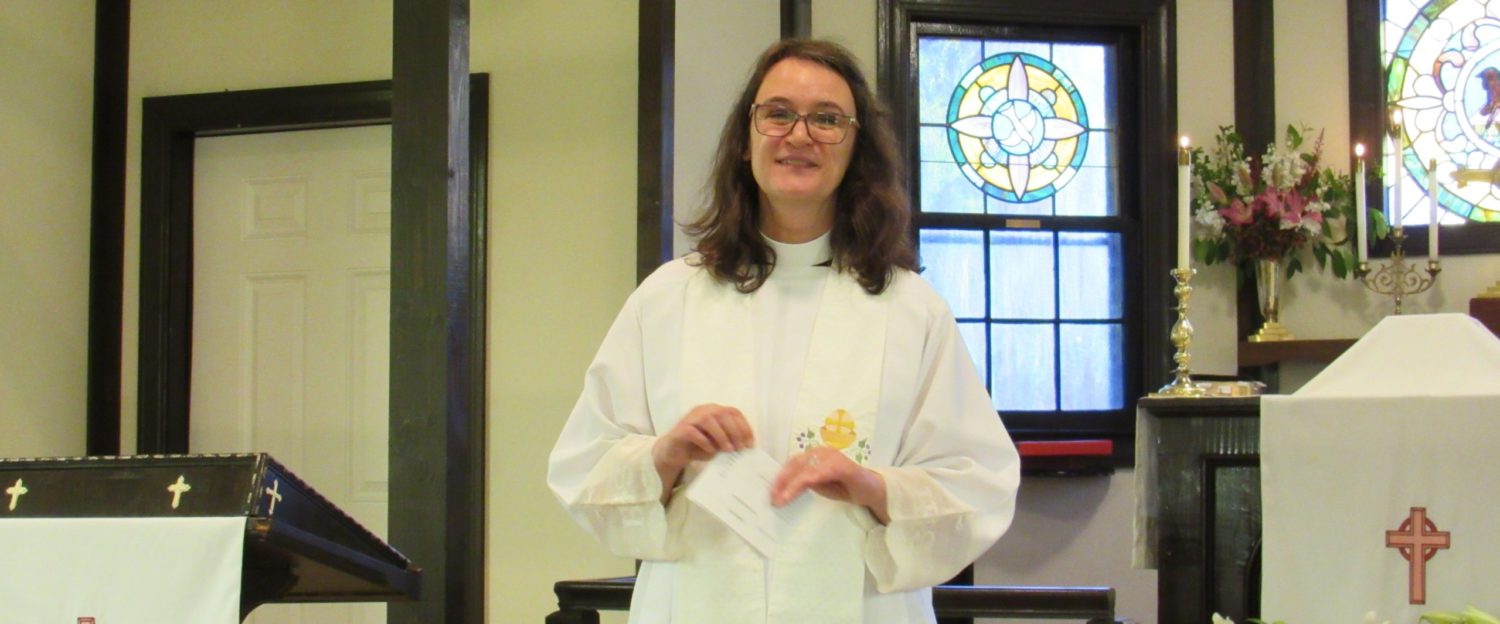
Well, it’s great to finally be here after quite a bit of snow and ice, and it looks like we’re going to have some rain later, so I am glad to have this window of opportunity to be with you all, on this last Sunday of Epiphany! And thank you so much for this invitation. My name is Fanny Belanger, I am a priest in the Diocese of East Carolina, and as you probably can tell I am a native French speaker. I am often asked what’s the correct way to pronounce my name and that would be [Fanny] – but I don’t expect you to do that. The interesting thing is that it’s also the way we pronounce Epiphany in French [Epi-phany] and so when I was a child I used to think that this season had something to do with me, and it made perfect sense since my birthday is in January. I know better now, and you probably do too, you probably know Epiphany means the manifestation of the divine. This season comes right after Christmas and ends this week, and this is what it’s all about: After Jesus is born, we learn how his divinity is manifested in different ways.
Now you may think, well, everywhere is the Gospel Jesus is going to manifest his divinity, by his healing and miracles, by his sermons and his parables, and that is certainly true. And yet, there are passages that are more obvious, and the one we have today is very obvious, this passage we call The Transfiguration, when Jesus goes on the mountain with Peter, James and John, his closest friends, and they witness this manifestation, and it’s so vivid that Peter still talks about it in his old age when writing the Epistle (2 Peter) we have just heard. So today we have a very obvious, very dramatic manifestation of Jesus’ divinity. Matthew tells us that Jesus started to “shine like the sun” and “his clothing became dazzling white”, and he was seen surrounded by Moses, the giver of the Law and Elijah, the greatest prophets of the Jews, and then they heard God’s voice saying: “This is my Son, the Beloved, with whom I am well pleased: listen to him”. The disciples fell to the ground, “overcome with fear” says the text. So again, very obvious and dramatic, and it is also a perfect loop in this season, on the last Sunday of Epiphany. Because if by any chance you remember the readings from the first Sunday after the Epiphany, Jesus’s baptism, we hear the same words coming from heaven: “This is my Son, the Beloved, with whom I am well pleased” (Matthew 3:17).
And so why am I reminding you of all of that? Because I think we need to notice that Matthew wants to make it easy for us. A lot of people now say Jesus was certainly a great man, or even a prophet, and why not – but it’s not the Christian teaching. Because in the Gospel it’s really clear that Jesus is greater than Moses and greater than Elijah. Jesus is God’sonly Son as we’re going to say in a few minutes in our Creed: (…)God from God, Light from Light, true God from true God (…) of one being with the Father. Sometimes people disagree with the Creed, they say it was written later in the history of the church and some stuff was added from the Scriptures…but no it wasn’t. We see today that it’s there, and it’s the heart of the Gospel. This story is at the center of Matthew’s Gospel (Ch 17/28) and we see that Jesus’ divinity is what the Gospel is all about, what our faith is all about. This is what is revealed to all of us.
Now another important thing to notice is how this revelation comes to us. This revelation comes indeed at a precise time in Jesus’ ministry. Again, we’re in the middle of Matthew’s Gospel. Until then Jesus had a lot of success, he had attracted a lot of people who found healing and came to faith through him. But opposition is starting to build up from the religious leaders who resent him, which will lead to his arrest, condemnation and death. Actually, our passage starts with the words “Six days after that” and so we may wonder about what’s just happened. What happened is that Peter has acknowledged Jesus as the Christ and then Jesus told his disciples he had to “go to Jerusalem and undergo great suffering (…) and be killed”. Peter, although he has such great faith, refuses to believe it. He says: “God forbids it, Lord! This must never happen to you” (16:21-22). And so this is what’s going on: The disciples believe, yes, they love Jesus, yes, but they are scared and do not understand God’s plan. And so Jesus takes them to the mountain.
So to me, this is what we need to understand: The Transfiguration is not meant for show, to dazzle the disciples or to prove them wrong in case they had any doubt. Rather the Transfiguration comes to confirm what the disciples already believed about Jesus. That’s what Peter says in his Epistle, he says that the vision on the mountain was meant in order that “the prophetic message [would be] more fully confirmed”, and God did that, did confirm their faith in this vision so their faith would be made strong, so they could go through the storm that was coming, Jesus’s passion and death, that we also will remember starting Wednesday during this time of Lent. The collect we have read at the beginning of our worship breaks it down for us: Jesus’ glory has been revealed on the holy mountain so we also may be strengthen to bear our cross. I love it that Peter has such beautiful words for his readers. Speaking about the Transfiguration, he says: You will do well to be attentive to this as a lamp shining in a dark place until the day dawns and the morning star rises in your hearts. I love it because that’s where we are in our lives, we’re in this suffering world – but there is a lamp shining. As we wait for the dawn, it is our belief that Jesus is the Son of God, God’s beloved, and the same Jesus, as he did on that day on the mountain for his disciples, this same Jesus touches us and says to each one of us “Get up and do not be afraid” – these are difficult, painful days but Jesus wants us to cling to this reality of his glory. There is the reality of this world, and there is God’s reality. Our pain is real, our darkness is real, but also: God’s glory is real, above all of it.
One day I heard a story that helped me understand that. There was this social worker who helped women suffering from domestic violence, and she says that one day she had to fly with one of these women to a new city, where she would be given a new home. She said it was this woman’s first time flying and when they got up in the air, looking at the window, the woman exclaimed: I didn’t know the sun shone about the clouds! Which of course was a beautiful thing to say as she was taken out of her nightmare to a new place where she would finally experience peace and safety. I love this story because that’s what happens on the mountain right? God’s glory shines above the world’s darkness. Those two realities, the pain and the glory, are both true, they coexist, but God’s glory is above it all. Probably a lot of us here experience some stress and distress at the suffering we witness everyday in the news, in our our communities, and in our own lives. And I think that on top of that we also experience the guilt of feeling powerless. Our medias and social medias make us believe that we have to take in all this pain and carry it, but in the end it does not necessarily lead us to accomplish a lot to address problems. We just end up quite depressed. I don’t think this what Jesus wants for his disciples. He sees their fragility and also their plain limitations in the face of evil, and so he takes them to a place where they can be strengthen, by reminding them of God’s reality.
And so we need the same right? We need to be reminded of God’s reality. When we make time for God, it should not be in order to flee our problems, rather it should be to be given what we need to face our problems – and to help others as we can. I remember when I was a young priest someone told me he loved his little church because it was his refuge against all that was wrong in the world, and he could forget it all during worship. Because I was a young priest, I was a little shocked and I replied that church was also supposed to challenge us! Now I understand that life bring enough challenges of its own, yet I still wonder if church is just meant to be a refuge. It’s very important we notice in our passage that yes Jesus wants to give his disciples this vision of his glory, but he also refuses to make a dwelling up there, he does not want Peter to take shelter in his little slice of heaven. When Peter offers to make camp up there, Jesus won’t listen to him. He will say: Get up, do not be afraid. (meaning also: You have work to do.) To us he still says:Don’t take refuge or comfort in the faith or in the church because you are afraid, rather use it as a source of strength and hope so you can do your job as a Christian in this world. This is what our time of worship is meant to be: to look at Jesus and also to listen to him, as God asks the disciples to do. Not to lose ourselves, to forget it all but to remember it all about God and so be well equipped, because we need God’s light to walk in the darkness. God does not need our prayers, we need to pray. God does not need our praises, we need to praise God so we’re aware of God’s glory. Maybe it’s not such a great image to say that the sun shines above the dark clouds, as if we were to run away to a better place when things get tough, rather I would say that God’s glory is like this lighthouse we have to keep our eyes on in the darkness. Or maybe another image would be to see it like an anchor, our faith in Christ is our anchor, we’re in the world with all its difficulties, but we cling to him in the storm so we can face it and he does not let go of us until the day dawns and the morning star rises in our hearts, as Peter puts it.
So as Lent approaches, I invite you to take all the time you need with God, take in God’s reality so you can take God’s reality into the world, so you can endure and resist, help others go through their own time of trial, so we can heal the world at our own level. Let yourself be reminded that whatever happens, we have this anchor that keeps pulling us back to Him. Amen.